
Table of Contents
-
- What is a Biomarker?
- Biomarker, genetic and genomic testing in lung cancer
- Biomarker testing in the era of precision medicine
- Techniques used for biomarker testing in lung cancer
- Benefits of biomarker testing
- Access to biomarker testing in Europe: Barriers and challenges
- Quality of biomarker testing in Europe
- The way forward for biomarker testing
- References
Biomarkers
What is a biomarker?
Biomarkers (also known as tumour markers) are molecules found in tissue samples or body fluids that can be measured to look for signs of a particular condition or disease, such as lung cancer. Examples of cancer biomarkers include mutations in a patient’s DNA and overexpression or otherwise abnormal presence of certain types of RNA or protein.
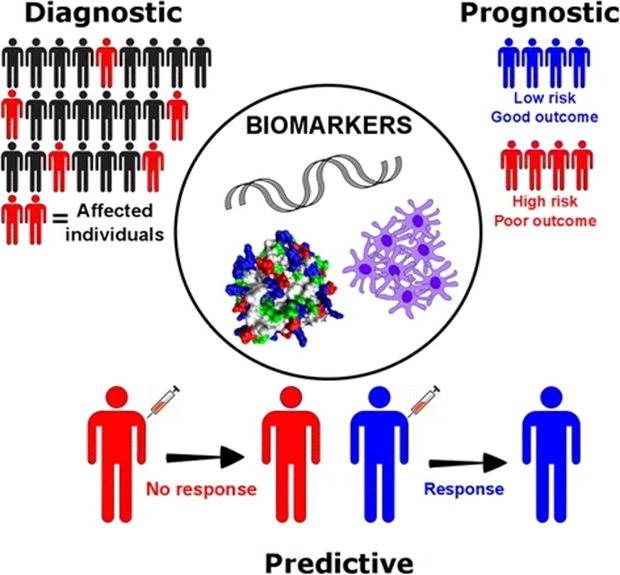
Biomarkers can be diagnostic, prognostic or predictive (Figure 1). Diagnostic biomarkers are used to detect or confirm the presence of lung cancer or a specific subtype of lung cancer. A prognostic biomarker is indicative of different disease outcomes, regardless of treatment, whereas a predictive biomarker helps to identify patients who are more likely to benefit from a targeted treatment.
Biomarkers are routinely used in clinical practice to guide treatment decisions, as well as to assess how well patients are responding to treatment. They can also be used to predict likelihood of resistance to some forms of targeted treatment, for example in patients with a mutation-driven form of cancer who also have other mutations known to limit the effectiveness of certain targeted therapies (de Jager, Lancet 2024).
Figure 1. Clinical uses of cancer biomarkers (Lim et al. 2018)
Biomarker, genetic and genomic testing in lung cancer
A patient diagnosed with lung cancer may undergo different methods of testing, depending on the type or stage of cancer they have. For example, a patient’s clinician may order genetic, genomic or biomarker tests, or a combination of these, to help guide the treatment decisions they will make with the patient. Biomarker testing can also be used to monitor long-term changes in the patient’s tumour burden.
Genetic testing is a term used to describe testing for inherited mutations in patients already diagnosed with cancer, or testing for inherited cancer risk in patients who have not been diagnosed with cancer but are at increased risk of having an inherited generic mutation based on family history.
Genomic testing is a term used to describe a range of tests used to identify uninherited DNA changes or ‘genomic alterations’ that can drive some forms of lung cancer. Testing is usually performed on one or more tissue samples taken from the patient. Many types of genomic alterations can be found in lung cancer patients, including EGFR, ALK, ROS1, BRAF, NTRK gene fusion, RET, KRAS, MET and more.
Biomarker testing is a broader term that includes genomic testing as well as tests for non-genomic markers that are not inherited (for example, levels of a targetable protein called PD-L1 found on some cancer cells). Biomarker testing is usually performed on one or more tissue samples (biopsies) taken from the patient, but some biomarkers can be measured in the blood (known as a liquid biopsy).
Biomarker testing in the era of precision medicine
Since the first targeted therapy for lung cancer was approved in Europe in 2005, clinical practice has been fundamentally transformed, ushering in a new era of precision medicine (de Jager Lancet 2024).
Thanks to the development of advanced technologies, it is now possible to carry out large-scale, high-quality genetic and genomic testing of cancer patients, allowing clinicians to identify and target a rapidly increasing number of mutations and oncogenic drivers. This means that, for many patients with lung cancer, cancer teams can determine the optimal course of action, delivering the right treatment at the right dose at the right time.
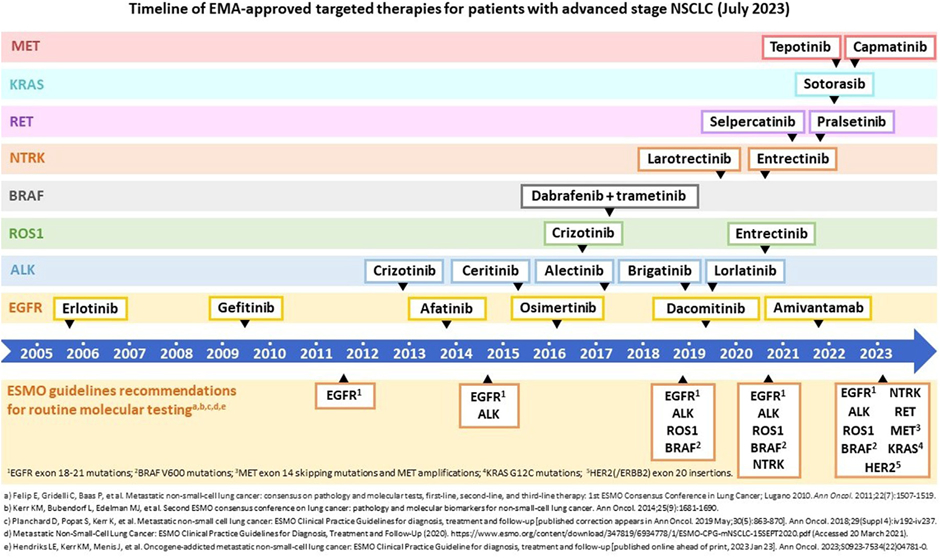
For European patients with advanced-stage non-small-cell lung cancer (NSCLC), the treatment landscape has expanded to include almost 20 approved therapies targeting eight different oncogenic drivers (Figure 2). However, access to these therapies and to the biomarker tests that guide their use in lung cancer varies enormously across Europe.
Figure 2. Timeline of targeted therapies approved by the European Medicines Agency for patients with advanced-stage NSCLC, 2005–2023 (de Jager Lancet 2024)
Techniques used for biomarker testing in lung cancer
There are several ways to test for lung cancer biomarkers, using single or multiple gene sequencing, or other techniques such as liquid biopsy, a non-invasive alternative conventional tissue biopsy (Bayle et al. 2023).
Single-gene testing can be done using a range of different laboratory methods (for example, immunohistochemistry and PCR), targeting a specific driver oncogene (Bayle et al. 2023). A Europe-wide survey found that single-gene testing for EGFR mutations (the most common genomic alterations found in NSCLC) is often carried out first (Hofman et al. 2023). If no EGFR mutations are found, further single-gene testing or a test for multiple genes may be ordered.
Multiple-gene testing refers to technologies that offer the ability to test for a broad panel of biomarkers at the same time. In clinical practice, the most common multiple-gene tests are done using next-generation sequencing (NGS), which can be used to test for biomarkers present in a patient’s DNA or RNA (Bayle et al. 2023). Current ESMO guidelines recommend using NRS technologies in patients with advanced non-squamous NSCLC (Mosele et al. 2020). However, the guidelines do not currently recommend routine use of NGS for all known and emerging biomarkers, for example KRAS.
Liquid biopsy samples a patient’s blood rather than removing tissue. In an estimated 30% of patients with NSCLC, tissue biopsy does not retrieve enough material for broad-panel biomarker testing (Lim et al. 2018). Combined with NGS, liquid biopsy offers the ability to rapidly test for several lung cancer biomarkers, for example circulating tumour DNA of driver oncogenes and tumour-associated proteins such as PD-L1 (Hofman et al. 2019).
Benefits of biomarker testing
For patients, the benefits of biomarker testing include:
-
-
- Earlier diagnosis of lung cancer
- Selection of targeted therapy based on an improved understanding of the underlying molecular characteristics of the patient’s cancer
- Increased confidence in, and satisfaction with, the treatment decisions taken with their clinician or cancer team
- Improved prognosis and disease outcome
-
For healthcare systems, biomarker testing allows for more targeted and efficient use of resources. Studies have shown that cancer biomarker testing can help reduce costs in healthcare systems by:
-
-
- Avoiding prescription of unsuitable therapies
- Improving patient outcomes, leading to less severe disease and fewer adverse events (Lux et al. 2018, Berdunov et al. 2022, de Jongh et al. 2022)
-
For more information on biomarker testing and oncogene-driven lung cancer, watch the video recording of the LuCE webinar held on this topic in February 2022.
Quality of biomarker testing in Europe
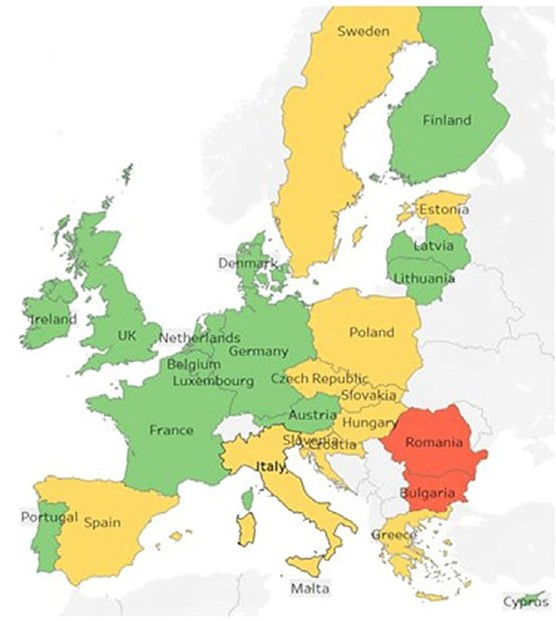
Quality of biomarker testing is another key metric, based on ISO accreditation and participation in at least one European Quality Assessment (EQA) scheme. The 2020 survey found that quality of biomarker testing was higher in western and northern European countries than in southern and eastern European countries (Normanno et al. 2022) (Figure 5).
The lowest proportions of ISO accredited facilities were found in Bulgaria, Croatia and Romania, and EQA participation was lowest in Slovakia (50% of testing facilities) and Greece (56%). Reasons for not participating in quality schemes included lack of funding and lack of requirement at the national level for EQA participation or ISO accreditation (Normanno et al. 2022).
Figure 5. Variability in biomarker test quality in 28 European countries (Normanno et al. 2022)
Green = high quality, yellow = medium quality, red = low quality.
The way forward for biomarker testing
Together with other European stakeholders, LuCE has called for greater consistency in access to broad-panel biomarker testing at the national level across the whole of Europe (CPE/EUCOPE/ESP/LuCE 2024).
To help deliver on the political commitment of Europe’s Beating Cancer Plan, action should be taken to encourage uptake of genomic testing in the clinic, through prioritising funding and reimbursement of broad-panel NGS and other advanced technologies. In France and Germany, national genomic plans are contributing to increased uptake of biomarker testing, but progress is not as rapid as it could be (CPE/EUCOPE/ESP/LuCE 2024).
LuCE and other European stakeholders have also called for national clinical practice guidelines to be updated to encourage broader access to advanced testing, and for clear regulatory pathways to be established at the European Union level for innovative biomarker testing techniques currently in development (CPE/EUCOPE/ESP/LuCE 2024).
References:
- Bayle A, Bonastre J, Chaltiel D, et al. ESMO study on the availability and accessibility of biomolecular technologies in oncology in Europe. Ann Oncol. 2023;34(10):934-945 [Full text].
- Berdunov V, Millen S, Paramore A, et al. Cost-effectiveness analysis of the Oncotype DX Breast Recurrence Score test in node-positive early breast cancer. J Med Econ. 2022;25(1):591-604 [Free full text].
- Cancer Patients Europe, European Confederation of Pharmaceutical Entrepreneurs (EUCOPE), European Society of Pathology, and Lung Cancer Europe (LuCE), June 2024. European stakeholders call on the EU to deliver on the ambitions of Europe’s Beating Cancer Plan by increasing access to genomic testing [Free full text].
- de Jager VD, Timens W, Bayle A, et al. Future perspective for the application of predictive biomarker testing in advanced stage non-small cell lung cancer. Lancet Reg Health Eur. 2024;38:100839 [Free full text].
- de Jongh FE, Efe R, Herrmann KH, et al. Cost and clinical benefits associated with Oncotype DX® test in patients with early-stage HR+/HER2- node-negative breast cancer in the Netherlands. Int J Breast Cancer. 2022:2022:5909724 [Free full text].
- Hofman P, Heeke S, Alix-Panabières C, et al. Liquid biopsy in the era of immuno-oncology: Is it ready for prime-time use for cancer patients? Ann Oncol. 2019;30(9):1448-1459 [Free full text].
- Hofman P, Calabrese F, Kern I, et al. Real-world EGFR testing practices for non-small-cell lung cancer by thoracic pathology laboratories across Europe. ESMO Open. 2023;8(5):101628 [Free full text].
- Lim SY, Lee JH, Diefenbach RJ, et al. Liquid biomarkers in melanoma: detection and discovery. Mol Cancer. 2018;17(1):8 [Free full text].
- Lung Cancer Europe (LuCE). IV LuCE Report on Lung Cancer: Early diagnosis and screening challenges in lung cancer. November 2019 [Free full text].
- Lux MP, Nabieva N, Hildebrandt T, et al. Budget impact analysis of gene expression tests to aid therapy decisions for breast cancer patients in Germany. Breast. 2018:37:89-98 [Full text].
- Mosele F, Remon J, Mateo J, et al. Recommendations for the use of next-generation sequencing (NGS) for patients with metastatic cancers: a report from the ESMO Precision Medicine Working Group. Ann Oncol. 2020;31(11):1491-1505 [Free full text].
-
Normanno N, Apostolidis K, Wolf A, et al. Access and quality of biomarker testing for precision oncology in Europe. Eur J Cancer. 2022:176:70-77 [Free full text].
-
Pestana RC, Sen S, Hobbs BP, et al. Histology-agnostic drug development – considering issues beyond the tissue. Nat Rev Clin Oncol. 2020;17:555e68 [Full text].