
Information on
Biomarkers
Definition
What is a biomarker?
Biomarkers are molecules found in tissue samples or body fluids that can be measured to look for signs of a particular condition or disease, such as lung cancer. Examples of cancer biomarkers include mutations in an individual's DNA and overexpression or otherwise abnormal presence of certain types of RNA or protein.
DNA, RNA, and proteins are three closely related types of biological molecules that represent different stages of how genetic information is stored, transmitted, and used in cells. Understanding their differences is key to interpreting genetic, genomic, and biomarker testing.
The cell's long-term genetic blueprint. Relatively stable, it is analysed to identify mutations — permanent changes in the genetic code — that may drive cancer development or influence treatment decisions.
An intermediary between DNA and protein, produced when a gene is "turned on." Testing RNA reveals which genes are being expressed and can help detect gene fusions not easily found at the DNA level.
The functional molecules produced from RNA instructions. Abnormal protein expression — such as overexpression of a cell-surface receptor — can serve as a biomarker and may be directly targeted by therapies.
In summary, DNA provides the instructions, RNA is the working copy of those instructions, and proteins are the final products that perform cellular functions. Biomarker testing may evaluate any of these levels to better understand cancer biology and guide treatment selection.
Types of biomarkers
Biomarkers can be classified as diagnostic, predictive, or prognostic.
Biomarkers are routinely used in clinical practice to guide treatment decisions and to monitor response to therapy. They can also help identify the likelihood of resistance to certain targeted treatments. For example, in mutation-driven cancers, the presence of additional co-mutations may reduce the effectiveness of specific targeted therapies (de Jager, Lancet, 2024).
Context
Biomarker testing in the era of precision medicine
At the start of this century, the survival rate for patients with stage 4 lung cancer was a bleak one year. However, as our understanding of lung cancer biomarkers has grown, there has been a significant shift in both prognosis and survival rates for these patients (Batra & Nathany, 2025). The approval of the first targeted therapy for lung cancer in Europe in 2005 marked a turning point, fundamentally transforming clinical practice and ushering in a new era of precision medicine (de Jager, Lancet, 2024).
Thanks to the development of advanced technologies, it is now possible to perform large-scale, high-quality genetic and genomic testing, enabling clinicians to identify and target an increasing number of mutations and oncogenic drivers. For people living with advanced-stage non-small-cell lung cancer (NSCLC) in Europe, the treatment landscape has expanded to include numerous approved therapies targeting different oncogenic drivers. However, access to these therapies and the biomarker tests that guide their use varies enormously across Europe, raising concerns about equity in cancer care.
Oncogenic driver mutations are genetic alterations that contribute to both the initiation and ongoing maintenance of cancer. They typically occur in genes encoding signaling proteins that regulate normal cellular proliferation and survival. When these genes are mutated, cancer cells gain a growth advantage, promoting their selection and expansion during tumour progression (Luo, Lam, 2023).
According to the ASCO Living Guideline (2026), the availability of biomarker testing results is essential for selecting an appropriate treatment strategy. Ideally, this includes comprehensive next-generation sequencing (NGS) alongside immunohistochemistry (IHC) for programmed death ligand 1 (PD-L1), HER2, and MET. Together, these tests guide treatment decisions, enabling either targeted therapy for NSCLC with actionable driver mutations or immunotherapy-based approaches for tumours without actionable alterations.
Access to complete molecular profiling before initiating first-line therapy has been associated with improved overall survival and greater cost-effectiveness in care delivery. Combining tissue- and blood-based molecular profiling can increase diagnostic yield and improve the likelihood of obtaining actionable results prior to treatment initiation. Platforms incorporating RNA sequencing further enhance the detection of actionable gene fusions.
In contrast, single-gene polymerase chain reaction (PCR) testing should generally be avoided outside of resource-limited settings, as it has lower sensitivity for detecting actionable genomic alterations and is inefficient in its use of tissue.
Testing in lung cancer
Biomarker, genetic and genomic testing in lung cancer
People diagnosed with lung cancer may undergo different types of biomarker testing, depending on the cancer subtype and stage. Clinicians may order genetic, genomic, or other biomarker tests — individually or in combination — to help guide shared treatment decisions. Early identification of actionable mutations, such as EGFR, ALK, and PD-L1 expression, allows for more personalised treatment planning and may inform decisions regarding adjuvant or neoadjuvant therapy.
Despite clear benefits, comprehensive biomarker testing remains underutilised in early-stage disease due to logistical challenges, tissue availability, and variability in clinical practice. Increasing awareness of guideline recommendations, integrating molecular testing into standard diagnostic workflows, and leveraging multidisciplinary collaboration can enhance uptake (Lee, Harpole, Silvestri, 2026).
Biomarker testing is a broader umbrella term that includes genomic testing as well as tests for non-genomic markers that are not inherited — for example, levels of a targetable protein called PD-L1 found on some cancer cells, which might guide immunotherapy. Biomarker testing is usually performed on one or more tissue samples (biopsies) taken from the tumour, but some biomarkers can be measured in the blood (known as a liquid biopsy).
Methods
Techniques used for biomarker testing in lung cancer
There are several ways to test for lung cancer biomarkers, including analysing samples for one or many alterations through sequencing. This can be done on tumour tissue or through a blood test called a liquid biopsy, which is less invasive compared to a tissue biopsy (Bayle et al. 2023).
Can be done using a range of laboratory methods (for example, immunohistochemistry and PCR), targeting a specific gene (Bayle et al. 2023). A Europe-wide survey found that single-gene testing for EGFR mutations — the most common genomic alterations found in NSCLC (adenocarcinoma) — is often carried out first (Hofman et al. 2023). If no EGFR mutations are found, further single-gene testing or a test for multiple genes may be ordered.
Refers to technologies that offer the ability to test for a broad panel of biomarkers at the same time. In clinical practice, the most common multiple-gene tests are done using next-generation sequencing (NGS), which can be used to test for biomarkers present in an individual's DNA or RNA (Bayle et al. 2023).
Samples blood rather than removing tissue. In an estimated 30% of people living with NSCLC, tissue biopsy does not retrieve enough material for broad-panel biomarker testing (Lim et al. 2018). Combined with NGS, liquid biopsy offers the ability to rapidly test for several lung cancer biomarkers, for example circulating tumour DNA (Hofman et al. 2019).
Source: Lim et al. 2018; 2024 IASLC Global Biomarker Testing Survey
Why it matters
Benefits of biomarker testing
For people living with lung cancer
- Earlier diagnosis of lung cancer
- Selection of targeted therapy based on an improved understanding of the patient's cancer
- Improved prognosis and disease outcome
For healthcare systems
Biomarker testing allows for more targeted and efficient use of resources. Studies have shown that cancer biomarker testing can help reduce costs by:
- Avoiding prescription of unsuitable therapies
- Improving patient outcomes, leading to less severe disease and fewer side effects (Lux et al. 2018, Berdunov et al. 2022, de Jongh et al. 2022)
For more information on biomarker testing and oncogene-driven lung cancer, watch the video recording of the Lung Cancer Europe webinar held on this topic in February 2022.
Across Europe
Quality of biomarker testing in Europe
The quality of biomarker testing is another key metric, based on ISO accreditation and participation in at least one European Quality Assessment (EQA) scheme. The lowest proportions of ISO-accredited facilities were found in Bulgaria, Croatia and Romania, and EQA participation was lowest in Slovakia (50% of testing facilities) and Greece (56%). Reasons for not participating in quality schemes included lack of funding and lack of requirement at the national level for EQA participation or ISO accreditation (Normanno et al. 2022).
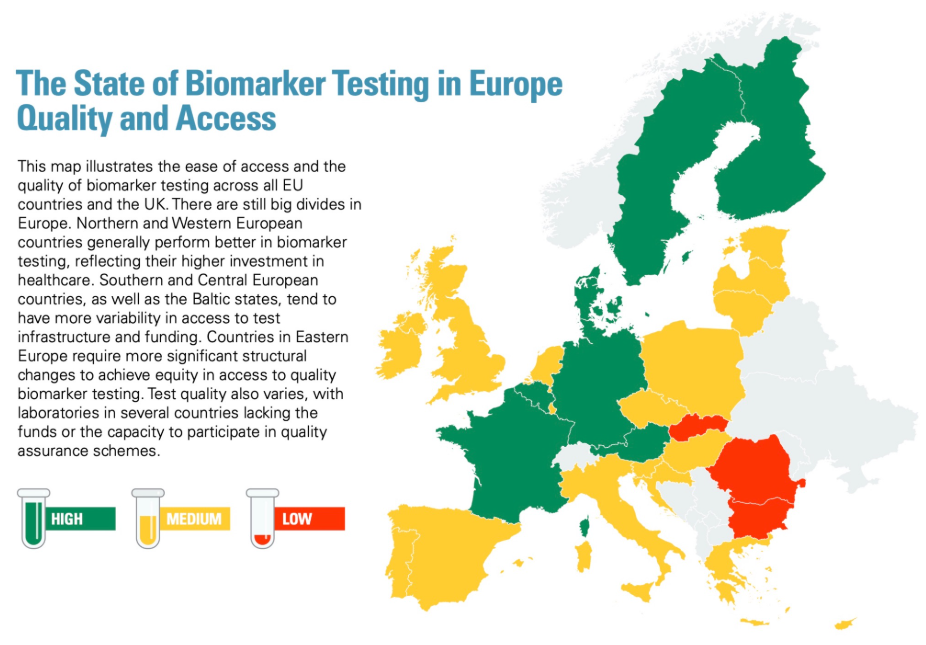
The State of Biomarker Testing in Europe: Quality and Access. Source: EFPIA, 2022.
This map illustrates the ease of access and the quality of biomarker testing across all EU countries and the UK. There are still big divides in Europe. Northern and Western European countries generally perform better in biomarker testing, reflecting their higher investment in healthcare. Southern and Central European countries, as well as the Baltic states, tend to have more variability in access to test infrastructure and funding. Countries in Eastern Europe require more significant structural changes to achieve equity in access to quality biomarker testing.
Results from the 2024 IASLC global biomarker testing survey show that biomarker testing in lung cancer has gone from "nice to have" to a "must have" for clinicians and patients around the world. But a significant gap remains in how clinicians perceive its importance based on disease stage.
Advocacy
The way forward for biomarker testing
Together with other European stakeholders, Lung Cancer Europe has called for greater consistency in access to broad-panel biomarker testing at the national level across the whole of Europe (CPE/EUCOPE/ESP/LuCE 2024). To help deliver on the political commitment of Europe's Beating Cancer Plan, action should be taken to encourage uptake of genomic testing in the clinic, through prioritising funding and reimbursement of broad-panel NGS and advanced diagnostic technologies. In France and Germany, national genomic plans are contributing to increased uptake of biomarker testing, but progress is not as rapid as it could be (CPE/EUCOPE/ESP/LuCE 2024).
Lung Cancer Europe and other European stakeholders have also called for national clinical practice guidelines to be updated to encourage broader access to biomarker testing, and for clear regulatory pathways to be established at the European Union level for innovative biomarker testing techniques currently in development (CPE/EUCOPE/ESP/LuCE 2024).
LuCE initiative
FAST-NGS: Generating real-world evidence to improve access to biomarker testing
Timely biomarker testing is fundamental to delivering precision oncology. However, despite advances in molecular diagnostics, many patients across Europe continue to experience delays in receiving next-generation sequencing (NGS) results, which can postpone biomarker-informed treatment decisions and contribute to inequities in access to personalised care.
To address this challenge, Lung Cancer Europe has launched FAST-NGS (Faster Analysis of Sequencing Turnaround Time), a real-world observational project designed to evaluate how biomarker testing pathways can be optimised in routine clinical practice. The project compares the conventional "send-out" NGS testing pathway with an in-house testing model, assessing turnaround times, workflow efficiency, and the practical feasibility of implementing local NGS testing in a community hospital setting.
The first pilot site is Metaxa Cancer Hospital in Athens, Greece, where Lung Cancer Europe is collaborating with Thermo Fisher Scientific to generate evidence on the operational and clinical impact of faster biomarker testing.
Although the initial focus is on non-small cell lung cancer (NSCLC), the NGS platform has pan-cancer capabilities, creating opportunities to extend the initiative to additional tumour types and European healthcare settings. As Lung Cancer Europe explores expansion to further pilot sites, FAST-NGS aims to provide practical evidence that can inform policy, improve diagnostic pathways, and support equitable access to precision medicine across Europe.
Read more about the FAST-NGS initiative →
Explore treatment access linked to biomarkers
Filter the Atlas by biomarker, lung cancer type, stage of disease and line of treatment.
Open the Atlas Licensed TreatmentsReferences
- Bayle A, Bonastre J, Chaltiel D, et al. ESMO study on the availability and accessibility of biomolecular technologies in oncology in Europe. Ann Oncol. 2023;34(10):934-945 [Full text]
- Batra U and Nathany S (2025) Biomarker testing in lung cancer: from bench to bedside. Oncol.Rev. 18:1445826. doi: 10.3389/or.2024.1445826
- Berdunov V, Millen S, Paramore A, et al. Cost-effectiveness analysis of the Oncotype DX Breast Recurrence Score test in node-positive early breast cancer. J Med Econ. 2022;25(1):591-604 [Free full text]
- Cancer Patients Europe, EUCOPE, European Society of Pathology, and Lung Cancer Europe (LuCE), June 2024. European stakeholders call on the EU to deliver on the ambitions of Europe's Beating Cancer Plan by increasing access to genomic testing [Free full text]
- de Jager VD, Timens W, Bayle A, et al. Future perspective for the application of predictive biomarker testing in advanced stage non-small cell lung cancer. Lancet Reg Health Eur. 2024;38:100839 [Free full text]
- de Jongh FE, Efe R, Herrmann KH, et al. Cost and clinical benefits associated with Oncotype DX® test in patients with early-stage HR+/HER2- node-negative breast cancer in the Netherlands. Int J Breast Cancer. 2022:2022:5909724 [Free full text]
- Hofman P, Heeke S, Alix-Panabières C, et al. Liquid biopsy in the era of immuno-oncology: Is it ready for prime-time use for cancer patients? Ann Oncol. 2019;30(9):1448-1459 [Free full text]
- Hofman P, Calabrese F, Kern I, et al. Real-world EGFR testing practices for non-small-cell lung cancer by thoracic pathology laboratories across Europe. ESMO Open. 2023;8(5):101628 [Free full text]
- IASLC (2024) Global survey on biomarker testing in lung cancer - 2024 update: iaslc.org
- ILCN (2024) Updated Biomarker Survey Results Show Paradigm Shift As More Respondents Now Consider Testing a "Must Have": ilcn.org
- J Clin Oncol 44, e15-e55(2026). Living Publication: "Therapy for Stage IV Non-Small Cell Lung Cancer With Driver Alterations: ASCO Living Guideline, v2026.3.2, May 28, 2026.
- Lee, Carrie, Harpole David, Silvestri, Gerard. Video: Examining Biomarker Testing in Early-stage NSCLC: targetedonc.com
- Lim SY, Lee JH, Diefenbach RJ, et al. Liquid biomarkers in melanoma: detection and discovery. Mol Cancer. 2018;17(1):8 [Free full text]
- Luo, S.Y., Lam, D.C. Oncogenic driver mutations in lung cancer. Transl Respir Med 1, 6 (2013). doi.org/10.1186/2213-0802-1-6
- Lung Cancer Europe. IV Lung Cancer Europe Report on Lung Cancer: Early diagnosis and screening challenges in lung cancer. November 2019 [Free full text]
- Lux MP, Nabieva N, Hildebrandt T, et al. Budget impact analysis of gene expression tests to aid therapy decisions for breast cancer patients in Germany. Breast. 2018:37:89-98 [Full text]
- Mosele F, Remon J, Mateo J, et al. Recommendations for the use of next-generation sequencing (NGS) for patients with metastatic cancers: a report from the ESMO Precision Medicine Working Group. Ann Oncol. 2020;31(11):1491-1505 [Free full text]
- Normanno N, Apostolidis K, Wolf A, et al. Access and quality of biomarker testing for precision oncology in Europe. Eur J Cancer. 2022:176:70-77 [Free full text]
- Pestana RC, Sen S, Hobbs BP, et al. Histology-agnostic drug development – considering issues beyond the tissue. Nat Rev Clin Oncol. 2020;17:555e68 [Full text]