Licensed Treatments
What is a licensed treatment?
In the context of this European online advocacy tool, the term ‘licensed treatment’ refers to a medicine approved for the treatment of lung cancer by one of the following regulatory authorities:
- European Medicines Agency (EMA)
- UK Medicines and Healthcare products Regulatory Agency (MHRA)
- SwissMedic
- Israeli Ministry of Health (IMoH).
Each regulatory authority has its own processes and timelines for licensing novel therapies. In Europe, it’s important to remember that obtaining an EMA marketing authorisation for a product does not guarantee that the product will be made available in each country. Potential barriers to local approval include current market conditions, pricing, and reimbursement, and – in some countries – health technology assessment. Unfortunately, these may cause delays in accessing these potentially life-saving treatments.

Where can I find current European guidelines on licensed treatments for lung cancer?
The European Society for Medical Oncology (ESMO) has developed interactive clinical practice guidelines for different types of lung cancer, including:
- Non-small-cell lung cancer (NSCLC)
– Early-stage and locally advanced (non-metastatic) NSCLC
– Oncogene-addicted metastatic NSLC
– Non-oncogene-addicted metastatic NSCLC
- Small-cell lung cancer (SCLC)
These can be viewed and downloaded via the ESMO website, alongside patient guides, webinars and other guideline-related resources. Patient guides are available in multiple languages.
For many European countries, national guidelines are also available. These do not always align with the ESMO recommendations.
In order to enhance early diagnosis, lung cancer screening programmes are incorporated in different countries. To know more about these programmes and find out where they are currently undergoing, see: https://euclinicaltrials.eu/search-for-clinical-trials/trial-map/?lang=en
What are the drivers of unequal access to licensed treatments across European countries?
Precision cancer care relies on a highly complex clinical pathway, and it often takes a long time for advances in diagnostic and therapeutic technology to filter down to cancer clinics. The pace of adoption of these technologies is limited by multiple financial, organisational, and regulatory hurdles, leading to inequitable access to precision cancer care at the country and regional levels. Examples include:
-
-
- Lack of harmonised European treatment guidelines, standardised quality indicators and uniform national lung cancer treatment plans
- Limited implementation of multidisciplinary tumour boards
- Lack of harmonised Health Technology Assessment pathways to promote access to innovation in lung cancer treatment across Europe
- Lack of reimbursement for some diagnostic and therapeutic technologies
- Limited expanded access and compassionate use programmes to promote access to treatments that are licensed but not yet reimbursed
- Limited availability of comprehensive molecular profiling, which in turn limits access to treatments targeting certain mutations and other actionable biomarkers (see “Information on Biomarkers”)
- Limited availability of other diagnostic technologies, for example imaging and imaging-guided diagnostics
- Limited access to modern radiotherapy equipment
- Limited patient involvement in decision-making processes, both at the national and European levels.
-
In our 2020 position paper on disparities and challenges in access to lung cancer diagnostics and treatment, LuCE laid out ten proposals to improve the situation across Europe and further the aims of Europe’s Beating Cancer Plan. Many of these proposals are in line with the European Cancer Organisation’s essential requirements for quality lung cancer care (ECO 2020) and ‘Leave No One Behind’ action report, published in January 2021 (Aapro 2021). They also align with a European call to action published in December 2022 (LuCE 2022), and the recent report by the Swedish Institute for Health Economics (IHE), published in April 2024 (Manxhuka 2024).
LuCE encourages European institutions, national governments, regulatory agencies, and the pharmaceutical industry to implement the proposals laid out in these documents. Our vision is to ensure that every European person with lung cancer has the same access to the best diagnostic procedures, treatments, and care as possible, without discrimination.
The role of financial toxicity in inequitable access to licensed treatments
The LuCE Access to Treatment Atlas currently includes information on nearly 50 branded treatments (over 30 active substances) licensed for lung cancer in Europe.
Newer lung cancer drugs are allowing patients to live longer and with a better quality of life, but, in many European countries, there remain significant barriers in accessing these treatments. Many of these barriers are caused by disparities in the costs associated with lung cancer. In some countries, particularly in eastern Europe, many licensed treatments for lung cancer are not reimbursed, or are available only when paid for by pharmaceutical companies or as an out-of-pocket expense for patients.
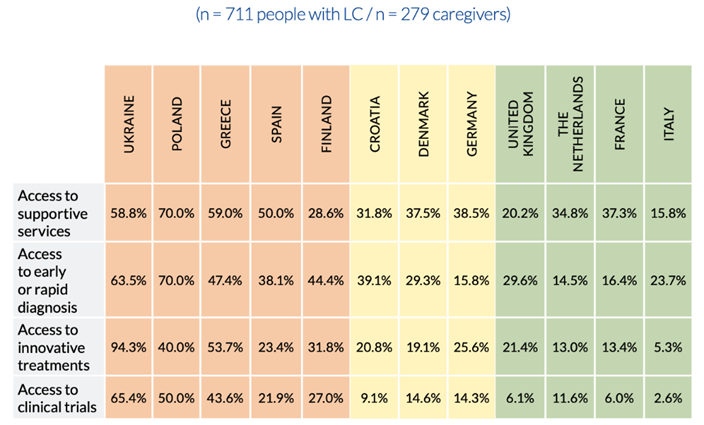
The financial impact on patients varies considerably. In a recent LuCE survey, the percentage of patients using more than 20% of their income to pay for their lung cancer expenses ranged from 5.9% in Denmark to 86.7% in Ukraine (8th LuCE Report 2024). For many patients, the financial toxicity of lung cancer results in limited access to newer licensed therapies, novel diagnostics, and clinical trial participation, and to public health, social and other supportive services (Table 1).
Often, those caring for patients living with lung cancer experience greater financial toxicity than the patients themselves (8th LuCE Report 2024). Approximately two-thirds (67.5%) of patients and carers surveyed by LuCE said that financial difficulties had a negative effect on their mental health.
For more information on how financial toxicity influences access to licensed treatments for lung cancer, read the LuCE report. LuCE has also produced eight country-specific reports on financial toxicity, and a report specific to ALK-positive lung cancer patients, who face unique challenges in terms of financial impact.
Table 1. Services impacted due to impact of lung cancer on personal finances (8th LuCE Report 2024)
Exploring the LuCE Access to Treatment Atlas
Every effort is made to ensure that the LuCE Access to Treatment Atlas accurately reflects access to licensed lung cancer treatments at the country level. However, disparities in access also exist within countries, at the local or regional level, and the Atlas may not accurately reflect these variations.
Click here to explore the LuCE Access to Treatment Atlas. You can filter the database by medicine, by country or by selected other parameters including biomarker, lung cancer type, stage of disease and line of treatment.
Access to treatment may also be possible through clinical trials. For more information see: https://accelerating-clinical-trials.europa.eu/index_en
If you need to search for clinical trials you can use this interactive map: https://euclinicaltrials.eu/search-for-clinical-trials/trial-map/?lang=en
References
-
- Aapro M, Lievens Y, Baird AM, et al., January 2021. Leave No One Behind – Delivering Innovation in Lung Cancer Care. Action Report. European Cancer Organisation; Brussels [Free full text].
- Berghmans T, Lievens Y, Aapro M, et al. European Cancer Organisation Essential Requirements for Quality Cancer Care (ERQCC): Lung cancer. Lung Cancer. 2020:150:221-239 [Full text]
- Lung Cancer Europe (LuCE), December 2022. Call to Action: Fighting lung cancer together as equals. [Free full text]
- Lung Cancer Europe (LuCE), November 2023. 8th Edition Of The LuCE Report – Financial Impact Of Lung Cancer: A European Perspective. [Free full text]
- Manxhuka B, Gustafsson A, Hofmarcher T; Swedish Institute for Health Economics (IHE), April 2024. IHE Report 2024:5. Patient access to treatment in advanced NSCLC – Are European health systems ready to measure what matters? [Free full text]